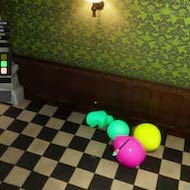
You wake up chained to a bed in a dim, unfamiliar bedroom, and the very first sound you hear is Granny’s slow, deliberate footsteps somewhere on the floor below. That’s the exact opening Granny Remake borrows note for note from the original escape-horror game it’s rebuilding, and within the first two minutes you already know the rules: stay quiet, find a way out of the restraints, and never let Granny hear exactly where you are.
Granny’s Hearing-Based AI as Granny Remake Rebuilds It
Granny doesn’t see you first — she hears you. Footsteps on bare floor, a door creaking open, an item knocked off a table, even sprinting across the wrong room at the wrong moment can pull her toward your location before you’ve had a chance to react. Granny Remake keeps this sound-based detection system as the entire backbone of its horror, and it’s the single detail that separates it from generic chase-and-hide games: you’re never actually fighting Granny directly, you’re managing how much noise you make while she patrols a house that was never built with stealth in mind.
Hiding is the immediate answer whenever her footsteps get close, and the game hands you the same toolkit the original made iconic — wardrobes you can duck inside, gaps under beds, and dark corners where crouching low is sometimes enough on its own. None of these hiding spots are foolproof. Duck into a wardrobe a half-second too late and Granny already has a lock on your position; hide too early out of panic and you waste a spot you might need later when she’s actually close enough to matter. Learning to read her footstep audio rather than just her visible model is the actual skill Granny Remake is testing, and it’s a skill that transfers almost exactly from anyone who’s already played the original.
Getting caught ends the run immediately. Granny grabs you, the screen cuts to her carrying you back to the bed you woke up in, and the five-day countdown that structures the whole game resets hard — any keys you’d found, any planks you’d pried loose with the crowbar, gone. That permadeath-style reset is one of the most discussed aspects of the whole Granny formula, since a single careless dash across a creaky hallway on day four can erase most of a long, careful run in one grab.
The slitherer adds a second layer of pressure once it shows up crawling through the vents and along the floor in certain rooms. It moves fast, it doesn’t behave like Granny does, and players who’ve spent real time with the house learn to treat vent-adjacent rooms differently once they know it’s active, checking sightlines before committing to loot a drawer or search a cabinet. Early in a run the house feels manageable because you’re only tracking one threat; by the time you’re deep into a save and the slitherer is active alongside Granny herself, every room requires listening for two completely different sound cues instead of one.
How Granny Remake’s Controls and Presentation Differ From the Original Granny
The most immediate difference anyone who’s played the original Granny will notice is the input scheme. The mobile version built its whole feel around touch — swiping to look around, tapping to interact, dragging items into an inventory bar with your thumb. Granny Remake trades all of that for mouse-look and WASD movement, which is a genuinely different way of navigating the same claustrophobic house. Turning a corner with a mouse is faster and more precise than swiping ever was, which shifts the tension slightly: you can react to a sound cue quicker, but you also lose some of the fumbling, thumb-cramped panic that made the mobile version’s close calls feel so specifically stressful.
Presentation gets a pass too, with lighting and textures reworked for a browser environment rather than a phone screen, and the game runs without needing anything installed, which is part of why a remake like this exists in the first place — it puts the same house in front of players who’d rather not download a mobile app just to try it. The layout of rooms, the placement of major landmarks like the main hall’s grandfather clock, and the overall geography of the house stay close enough to the original that anyone who’s escaped the mobile version before will recognize exactly where they are within the first couple of rooms.
Whether Granny Remake is harder or easier than the original is genuinely debated rather than settled. Faster, more precise mouse movement makes physically escaping a spotted chase slightly more forgiving, but Granny’s detection logic and patrol behavior are carried over largely intact, so the core challenge — staying quiet, planning routes, managing limited items — hasn’t gotten meaningfully softer. Players who grew up on the touch version sometimes describe the remake as feeling less suffocating simply because mouse-and-keyboard input is more familiar and less physically awkward than swiping on glass, which says more about control comfort than about any actual difficulty change made on purpose.
The trade-off that gets argued about most is atmosphere. Some longtime fans of the original insist the touch controls’ clumsiness was accidentally doing narrative work, making you feel as helpless as the character you’re playing, and that a smoother mouse-driven version loses a sliver of that dread even while keeping every mechanic intact. Others find the remake’s responsiveness is simply an improvement with no real downside, since a horror game built around timing shouldn’t be fighting its own control scheme on top of fighting Granny. Both opinions show up constantly wherever the remake gets discussed.
Hiding Spots and Escape Routes Granny Remake Keeps From the Original
The crowbar remains the single most important tool in the house, exactly as it was in the original Granny. Wooden planks block off entire sections early on, and prying them loose with the crowbar is usually the first real objective once you’ve broken loose of the starting restraints. Every plank removed opens up more of the house to search, and more house to search means more places for Granny to be while you’re trying to think.
Escape itself was never going to be a straight walk to the front door, and Granny Remake keeps that structure faithfully. Getting out usually means solving a chain of small problems across multiple rooms — locating hidden keys, working out a combination for a locked box, gathering car parts to make the garage route viable, or finding an alternate path through the sewer grate that bypasses the ground floor entirely. Which route is realistic on a given run depends heavily on what you’ve already found and how much of the house you’ve dared to explore, since backtracking through a room Granny is actively patrolling is rarely worth whatever item you left behind.
Items you pick up along the way aren’t just checklist objects, either. Bear traps can be carried and dropped somewhere useful, turning one of Granny’s own tools against her or the slitherer if either one wanders into it at the wrong moment. A shotgun, when you’re lucky enough to find one, buys a small window of safety rather than acting as a real solution, since ammo is scarce enough that most experienced players save it for a genuine emergency instead of using it the moment they find it.
Five in-game days is the window Granny Remake gives you before the whole run is effectively over, and that countdown is what keeps every decision feeling weighted rather than casual. Spend day one cautiously mapping rooms and you’ll know the house well enough by day three to move with real intention; rush the early days recklessly and you’ll likely still be guessing at key locations when the clock runs out. That tension between careful exploration and running out of time is the same tension the original built its entire reputation on, and Granny Remake hasn’t tried to reinvent it — it’s just given players a new set of hands to play it with.
Granny Remake succeeds mostly by knowing exactly what not to touch, keeping Granny’s sound-based hunting, the crowbar-and-planks progression, and the five-day countdown intact while handing the whole house a control scheme built for a keyboard instead of a touchscreen, and that grandfather clock chiming somewhere on the ground floor is still the sound that makes most players freeze the same way it always has.