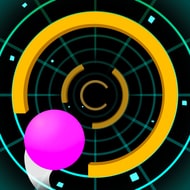
Rolly Vortex looks like a game about a ball rolling through a colorful tunnel, but it plays like a game about color memory at speed. The ball has a color. The rings it must pass through have segments of matching and non-matching colors. The longer a run goes, the faster new rings arrive, and the gap between seeing a ring’s segment arrangement and actually positioning the ball to pass through the matching gap shrinks until it’s smaller than any conscious processing can handle. Players who make it far aren’t reading the rings anymore — they’re reading the spaces between them.
| Genre |
Arcade / Endless Runner |
| Platforms |
Mobile (iOS, Android), Browser |
| Controls |
Tap or drag left/right |
| Ball Colors |
Multiple rotating palette |
| Objective |
Pass through matching color ring segments |
How the Color Ring Mechanic Works
Rolly Vortex sends a ball rolling down a cylindrical tunnel. At intervals along the tunnel, color-segmented rings appear across the path. Each ring is divided into colored segments — typically three or four distinct colors arranged in arcs around the ring’s circumference. The ball must pass through the segment that matches the ball’s current color. Passing through a non-matching segment, or hitting the solid wall between segments, ends the run immediately.
The ball’s color changes over time, and the color the ball currently displays is the color of the segment the player must find in each incoming ring. This is Rolly Vortex’s central tension: the ball’s color might have changed since the last ring, and the matching segment in the upcoming ring is somewhere around the circumference — possibly directly ahead, possibly requiring the ball to shift left or right before the ring arrives. Reading the ring while compensating for the ball’s current color and deciding how far to move before the ring reaches the ball is the entire skill the game develops.
Early rings arrive slowly and the segments are large, giving new players time to identify the matching segment, shift position, and pass through cleanly. As distance increases, the speed of incoming rings accelerates, the segments become narrower, and the time between rings shortens. By the high-score ranges, ring arrival is fast enough that the correct approach is to establish a general position based on the last ring’s arrangement and the known color, then micro-adjust in the final half-second before contact.
Ball Position and Why the Center Is a Trap
New Rolly Vortex players tend to keep the ball centered and dart in one direction only when a ring approaches. This works at low speeds, but it produces a fundamental positioning problem as speed increases: when the matching segment is at an extreme left or right position, a center-start move doesn’t reach it in time. The ball is moving from center toward the edge while the ring is moving from ahead toward the ball, and the two don’t converge at the matching segment.
Experienced Rolly Vortex players maintain a moving average position based on where recent matching segments have appeared. If the last three rings had matching segments left-of-center, the ball should be positioned left-of-center during the approach to the fourth ring, adjusting only if the fourth ring’s segment appears right-of-center. This approach reduces total lateral movement per ring and keeps recovery distance smaller when a mid-approach correction is needed.
The center-trap is also a color awareness problem. Players who are uncertain about the ball’s current color default to center while they figure it out. By the time they’ve confirmed the current color and found the matching segment, the ring is too close to reach a segment that’s more than about thirty percent of the tunnel width away from center. Learning to track the ball’s color change moment — the specific visual pulse that indicates a color shift — and updating the target position immediately after the change is what allows experienced players to stay in pre-positioned postures rather than reactive ones.
Speed Phases and the Risk of Anticipation
Rolly Vortex has distinct speed phases where the tunnel’s forward movement accelerates noticeably. These phases are predictable in their timing — the game announces them with a brief visual pulse in the tunnel walls before the speed increase lands. Players who recognize this pulse have roughly one second to mentally prepare for the incoming tempo change before it affects the gap available for ring reading.
At higher speed phases, the risk of anticipating the next ring’s segment too early becomes meaningful. If the ball is already moving toward where the matching segment was on the previous ring, and the current ring has the matching segment in a different position, the pre-committed movement puts the ball in exactly the wrong place. Fast runs in Rolly Vortex require a specific combination of pre-positioning and late-adjustment: start moving toward the expected segment location, but keep the adjustment window open until the ring is close enough that the actual segment location is confirmed. This is harder than either pure reaction or pure anticipation because it requires both.
What Players Discuss About Rolly Vortex
The most consistent complaint about Rolly Vortex in player communities concerns what they call “impossible rings” — rings where the matching segment appears at the extreme edge of the tunnel, arrives at a speed phase where lateral movement to that edge is not achievable in the available time, and produces a failure that feels procedurally unfair rather than skill-dependent. These moments exist and they are a genuine tension in the game’s design. Rolly Vortex generates ring segment arrangements procedurally, which means the distribution of “hard” segment positions is not guaranteed to stay within achievable limits at every speed phase.
Most experienced players accept some procedural bad luck as part of the game’s format and measure their skill by average performance across many runs rather than any single peak run. The community consensus is that Rolly Vortex is approximately 85-90 percent skill and 10-15 percent procedural variation at high scores, which places it in similar territory to other procedurally generated arcade games. Players who approach it with that expectation find the difficulty curve fair; players who expect full determinism from a procedural system find the occasional impossible ring frustrating enough to affect their enjoyment of otherwise high-quality runs.
Questions Rolly Vortex Players Ask
- Does the ball’s color change on a timer or based on rings passed? The ball’s color changes on a distance-based or rings-passed trigger rather than a fixed time interval. Color changes occur at predictable intervals relative to ring frequency, not independently of them. This means that at higher speeds — when rings are arriving faster — the ball’s color also changes more frequently in terms of real time, which increases the difficulty of tracking both the color state and the ring segment simultaneously.
- Is there a way to pause Rolly Vortex mid-run? Most versions include a pause function accessible through a menu button or back button. The pause does not reset the run; resuming picks up exactly where play stopped. However, pausing during a high-speed phase can make the resumption harder because the visual rhythm established during active play is broken. Players who use pause as a strategic tool to evaluate an upcoming ring section at lower cognitive load often find that the resumed run feels faster than the pre-pause run, because the flow state interrupted by the pause takes a moment to reestablish.
- Does Rolly Vortex get any harder after a certain distance or does it reach a maximum difficulty? Rolly Vortex increases in difficulty up to a certain speed ceiling that appears to be reached around the five-hundred-meter range in most versions. After that ceiling, the speed and ring frequency remain approximately constant, and continued improvement in score is determined by sustained execution quality rather than further escalating challenge. This means that players who survive to the ceiling zone are essentially playing at maximum difficulty indefinitely, and the competitive range for high scores begins at the ceiling and extends based on consistency.
Rolly Vortex earns its place as one of the more mechanically honest color-based arcade games available because it ties its difficulty directly to the same color-recognition system it introduces in the first ten seconds. The ball, the ring, the matching segment — that three-part relationship never changes, only the speed at which you must resolve it. Players who eventually reach the maximum speed ceiling and begin competing for distance within it find that the game has quietly taught them to track two pieces of information simultaneously at speeds that would have felt impossible when they first started. That specific development — reading color and position at the same time while moving through a space that allows essentially no error — is Rolly Vortex’s lasting contribution to players who stick with it long enough to earn it.