You tap at the wrong moment and the ball slams into a blue segment while showing yellow — not because the barrier was fast, but because a color-swapping star three gates back already changed things and you didn’t register it. That half-second gap between what you believe the ball’s color is and what it actually became after the last star is the entire game. Color Switch is built on exploiting that gap, and it tightens it further every few obstacles without adding a single new rule.
| Genre |
Arcade / Reflex |
| Platforms |
iOS, Android, Browser |
| Release Year |
2015 |
| Controls |
Single tap |
| Ball Colors |
Yellow, Blue, Pink, Purple |
The Core Mechanic and the Color Star System
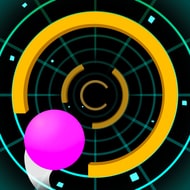
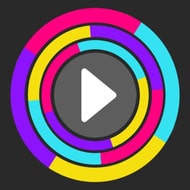
Color Switch puts a ball on a vertical path and asks you to guide it through a series of barriers. Each barrier is divided into colored segments — yellow, blue, pink, and purple — and the ball can only pass through a segment that matches its current color. Any other segment ends the run instantly. That rule is simple. The complication comes from star collectibles scattered between barriers.
Every star collected changes the ball’s color. The new color is assigned procedurally, which means it might shift or stay the same. Players who assume the ball holds its color between stars consistently hit barriers where they’re aiming at a yellow segment while the ball has already become pink two stars ago. The skill Color Switch actually tests is not raw reaction speed — it’s accurate color-state tracking under escalating time pressure. Knowing what color you are right now, at this moment, is harder than it sounds when stars have been flying past for thirty gates.
This is why Color Switch is notoriously difficult to improve at through intuition. The failure state feels arbitrary until players start deliberately confirming their current color after every star. Veterans describe this shift as “locking on” — the moment the game stops feeling chaotic and starts feeling readable. Everything before that moment is just reacting to consequences; everything after is anticipating them.
Barrier Types and What Each One Demands
Color Switch uses several distinct barrier patterns, each requiring a different reading strategy:
- Rotating rings — the most common type. A circle divided into four colored segments spins at a fixed speed. Watch one full rotation before entering to find the segment rhythm, then commit during the matching color’s window.
- Oscillating fans — a segment arc that sweeps back and forth. The matching segment moves fastest at the extremes of the sweep and slowest at the center. Most players rush the center and arrive when the window has already closed.
- Pulsing rings — expand and contract without rotating. The gap is widest only at the peak expansion. Entry must happen during that brief open point, not during approach.
- Stacked barriers — two different barrier types positioned close together with no safe hover space between them. You have to read both gaps before entering the first.
- Counter-rotating pairs — two rings spinning in opposite directions. Their matching segments align for roughly one quarter of a second per cycle, which is the only valid entry window.
Beginners treat every barrier as the same problem. Experienced players recognize that the reading strategy changes completely by barrier type — slow oscillations reward patience, counter-rotating pairs reward commitment at the exact moment of alignment rather than any kind of gradual approach.
Why Long Runs End Where They Do
The most consistent mistake in Color Switch is watching the ball instead of the next barrier. The ball is the object being controlled, but the correct tap moment is determined entirely by what is happening two levels ahead. Players who track the ball itself will always react to barriers rather than anticipate them, which means they are using reaction time as a primary tool instead of pattern reading and position timing.
Color Switch has no checkpoints. A run reaching gate forty that fails at gate forty-one returns to zero. This creates a compounding psychological pressure — the longer a run goes, the more aware players become that they are on a streak, and that conscious awareness disrupts the automatic processing that makes long runs possible in the first place. The community calls this “choking the gate” — when awareness of a streak produces a failure that would never happen during low-stakes practice. It affects players who have technically mastered the mechanics but haven’t learned to suppress streak-consciousness.
A third problem affects the twenty-to-thirty-gate range specifically. After a clean first stretch, the temptation is to maintain speed and tap through barriers quickly. Color Switch responds by generating faster barriers past that range, and the combination of self-imposed speed and increasing barrier speed creates a collision window smaller than either factor alone would suggest. Deliberately slowing the tap rhythm slightly when barriers start accelerating is counterintuitive but effective — the game wants you to rush, and resisting that pull is a skill in itself.
Mode Variations and the Skills They Isolate
Color Switch includes several modes that emphasize different aspects of the core problem:
- Classic — the standard run. Barriers and stars alternate with increasing speed and complexity. No safety net, no pace control.
- Switch — barrier movement pauses when the ball is stationary. This removes time pressure from barrier reading entirely, making it useful for studying rotation patterns and safe entry windows without the approach speed complication.
- Bounce — the ball bounces automatically and the player only controls timing, not upward movement. Runs faster than Classic and strips away all hover decisions. Pure color-tracking under speed.
- Rush — maximum barrier speed from the start. Fewer total gates, immediate intensity. Used by players stress-testing peak reaction state.
Players who plateau in Classic frequently make measurable progress by spending time in Switch, where they can study individual barrier cycles without failure pressure. The community treats Switch as a training environment — skills developed there transfer directly to Classic, even though the modes feel very different while playing them. Specifically, Switch teaches players to identify exactly when the matching segment reaches its optimal entry point, which is the same information Classic requires but without the milliseconds of runway to process it.
What the Community Tracks and What It Debates
Competitive Color Switch focuses on Classic high scores. Gate counts above 100 are considered solid, and anything above 200 is competitive at the community level. The procedural barrier generation means any two runs face different sequences, which keeps comparisons reasonably honest — a 200-gate run cannot be dismissed as a lucky sequence because the patterns always vary. Personal bests are the primary metric, with community leaderboards secondary.
The persistent debate in the Color Switch community centers on what players call “color lock” situations — moments where a star immediately before a complex barrier generates the one color least suited to passing that barrier in its current rotation position. This isn’t a bug; it’s a byproduct of the procedural system. But it generates ongoing disagreement about whether Color Switch is fully skill-based at high gate counts or whether run luck plays a meaningful role past a certain point. Most veteran players accept that procedural luck exists and that consistent performance across many runs, rather than any single peak score, is the real skill measure. The criticism that the game is partly luck-dependent has never fully resolved, and it’s a fair one.
Common Questions About Color Switch
Does it matter which color you start as in Color Switch?
The starting color is assigned randomly at the beginning of each run and cannot be chosen or influenced in Classic mode. Because the first star changes the color regardless of the starting state, and early barriers are typically simpler than later ones, the starting color rarely has meaningful impact on a run’s early success. Players who claim certain starting colors feel harder are usually responding to the first barrier combination rather than the color assignment itself.
Why do some Color Switch runs feel impossible from the very first gate?
Procedural generation occasionally produces early sequences where the star placement and barrier type combination is tight enough to feel unfair. These sequences exist and they are genuine outliers in the difficulty distribution. The community acknowledges that some run starts are harder than average — this is one of the acknowledged weaknesses of purely procedural content generation. The standard practice is to restart immediately if the first star drops a color that conflicts with an incoming counter-rotating pair, rather than attempting to thread an opening that the sequence has essentially made unreasonable.
Can a Color Switch training routine actually extend the gate ceiling?
Yes, and the most effective ones use mode rotation rather than repetitive Classic runs. A session that includes Switch mode for barrier-pattern study, Bounce for color-tracking under speed, and Classic for applied pressure consistently extends gate ceilings faster than Classic alone. Fifteen minutes in Switch followed by ten in Classic is the structure that experienced players recommend most often, specifically because Switch isolates the reading problem that Classic obscures behind time pressure.
Color Switch has stayed relevant for a decade because the lag it exploits — the gap between believing your ball is yellow and discovering it became pink three stars ago — never fully disappears with practice. It only shrinks. The rotating rings, the pulsing barriers, the counter-spinning pairs are all different shapes built around the same single question of whether your color model matches the one on screen. When it does, you pass. When it doesn’t, the ball hits a segment and the run ends at gate forty-one, and the only thing to do is start again from gate one and track the star colors more carefully this time.