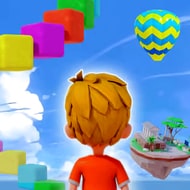
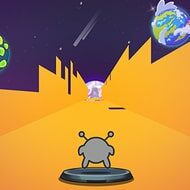
The flip in G-Switch 4 does not feel like pressing a button — it feels like stepping off a ledge and hoping the other surface catches you. That micro-moment of uncertainty, where the character has left one surface and hasn’t yet confirmed footing on the other, is the game’s actual difficulty. The flip mechanic itself is simple. The timing of when to commit to a flip, and what to do about the floor becoming the ceiling mid-run, is not.
| Genre |
Endless Runner / Arcade |
| Platforms |
Browser, Mobile |
| Players |
1–8 simultaneously |
| Controls |
Single button / tap |
| Mechanic |
Gravity flip on tap |
The Gravity Flip — and What It Actually Changes
G-Switch 4 places a character on a platform surface — either the floor or the ceiling. The character runs forward automatically at a fixed and increasing speed. Pressing the flip button (or tapping the screen) instantly reverses gravity for that character: if running on the floor, the character drops upward to the ceiling; if running on the ceiling, the character falls back to the floor. The character cannot stop, slow down, or jump — only flip.
This single constraint produces a surprisingly rich obstacle space. Every gap in the platform surface is a potential problem: a gap at floor level requires either flipping to the ceiling before the gap or surviving on the ceiling until the floor resumes. A gap at ceiling level poses the same problem from the other direction. Simultaneous gaps on both surfaces produce a brief moment where neither surface is safe, requiring the character to pass through the gap zone without contact — which means entering the gap while traveling between surfaces, neither touching floor nor ceiling for a specific interval.
What makes G-Switch 4 substantially harder than the preceding entries in the G-Switch series is the addition of new platform configurations and obstacle types that force flips in rapid succession. Sections that require three or four flips within two seconds of each other appear in the later stages and represent the skill ceiling for most new players — not because the required timing is theoretically impossible, but because the cognitive model of “I am currently on this surface and need to be on that surface” has to update four times faster than natural processing allows.
Single Player vs Multiplayer — Two Different Games
G-Switch 4 supports up to eight simultaneous players in multiplayer mode, each controlling a separate character with their own designated flip key. In multiplayer, all characters run through the same obstacle sequence simultaneously. A player is eliminated when their character fails to clear an obstacle, and the last surviving character wins.
Multiplayer changes G-Switch 4’s character fundamentally. Single player is about maximizing a personal distance score in an infinite-runner format. Multiplayer is about surviving longer than the other players, which means the relevant skill is not peak performance but consistency under pressure in shared conditions. Two players with equivalent single-player scores might perform very differently in multiplayer because multiplayer adds the psychological element of watching adjacent characters — a player who would stay calm on their own sometimes panics and flips too early when they can see another player dying right next to them.
Experienced G-Switch 4 multiplayer players describe developing “tunnel vision” as a skill: the ability to focus exclusively on their own character’s position and ignore the visual noise of seven other characters flipping and dying around them. This is the same selective attention skill that appears in other competitive multiplayer games, but in G-Switch 4 it’s particularly valuable because the obstacles are identical for all players — success and failure come entirely from managing individual attention and flip timing, not from strategic variation.
The Platform Gap Problem and How to Read Ahead
G-Switch 4’s platform gaps are the primary challenge and the primary source of run-ending deaths. Gaps appear as breaks in the platform surface, and the character falls or flies through them unless the flip has been timed to transfer surfaces before the gap is reached. The key reading skill is identifying gaps early enough to make a deliberate flip rather than a reactive one.
At lower speeds, gaps are visible far enough ahead that players can confirm their surface choice, commit to a flip, and land cleanly on the opposite surface before the gap arrives. At higher speeds, the approach window compresses to the point where the gap is recognizable and the flip must happen almost simultaneously. The challenge is that G-Switch 4 also generates “fake-out” patterns — sections where the platform surface narrows but does not fully break, which looks like an approaching gap but requires staying on the current surface. Flipping preemptively on a fake-out is as fatal as missing a real gap.
Reading the difference between an approaching gap and an approaching narrowing requires pattern familiarity. In early sessions, both look similar enough that players either over-flip (treating narrowings as gaps) or under-flip (treating gaps as narrowings until it’s too late). Experience calibrates the distinction. Players who have run G-Switch 4 for several sessions develop a visual threshold — a specific width of platform break that triggers a flip response — that becomes reliable without requiring conscious measurement of each obstacle.
Speed Escalation and the Reflex Ceiling
G-Switch 4’s speed increases gradually through a run, and the obstacle density and complexity increase alongside it. Early sections are spaced generously — single flips with long approach windows, alternating surfaces that don’t require rapid reversal. Later sections introduce the rapid-flip sequences and close-spaced gaps that represent the game’s actual difficulty peak.
Most players find their personal difficulty ceiling in G-Switch 4 around the same point in each run — a section where the flip requirement exceeds what they can execute deliberately and requires either pure reflex or a kind of pattern familiarity that bypasses deliberate processing entirely. The players who push past this ceiling typically describe learning the specific obstacle sequences at that difficulty level well enough that the flip timing becomes part of a memorized pattern rather than a fresh decision each time.
What the G-Switch 4 Community Values
The G-Switch 4 community primarily trades high scores from single-player runs and outcome records from local multiplayer sessions. The game doesn’t have an integrated online leaderboard in most versions, so community comparison happens through shared screenshots and video clips. Players who reach deep into a single-player run — past the first several hundred meters at maximum speed — are recognized as having achieved a level of consistency and pattern memory that most players don’t develop.
The multiplayer community is less focused on scores and more focused on elimination order: specifically, on being the last surviving character in an eight-player session. The game’s design in multiplayer creates natural social moments — when seven characters die simultaneously on the same gap and one survives, or when a player survives a section that appeared to wipe the entire field. These moments are memorable in a way that single-player high scores are not, which is why local multiplayer remains a significant part of how G-Switch 4 is played even now.
One criticism that surfaces in community discussions about G-Switch 4 relative to earlier entries is the transition from single-player infinite runner to a multiplayer-focused experience. Some players feel that the later entries deprioritize the single-player skill ceiling in favor of multiplayer accessibility, and that the hardest obstacle sequences that appeared in earlier G-Switch games are somewhat smoothed over in G-Switch 4 to make the game more functional as a group activity. This is a fair characterization — G-Switch 4 is the most accessible entry in the series and also, for dedicated single-player runners, the least demanding at its skill ceiling.
G-Switch 4 is the kind of game that reveals something specific about how players learn physical habits under pressure. The gravity flip is conceptually simple — one button, two states. But the moment the run reaches maximum speed and the gaps arrive faster than deliberate thought allows, every player discovers that their reflexes have developed a model of the platform surface that is several steps ahead of their conscious reading. G-Switch 4’s multiplayer sessions and its single-player distance chases are both expressions of the same underlying skill: trusting that your training has built the right model, and committing to the flip before you’ve fully confirmed that you need it.