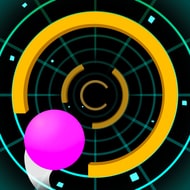
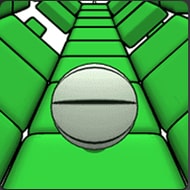
Slope Tunnel looks like Slope and sounds like Tunnel Rush, but it plays like neither. Where Slope gives you a wide track to navigate with clear edge boundaries, Slope Tunnel wraps that track into a cylinder where the edge boundary is also the ceiling, and where Tunnel Rush gives you stationary obstacles to dodge through, Slope Tunnel puts those obstacles on a surface that is itself moving and tilting relative to your position. The feel of Slope Tunnel is specific: like driving through a pipe that is both a road and a wall simultaneously.
Inside the Cylinder — What Makes Slope Tunnel Different
Slope Tunnel places a ball inside a cylindrical tunnel that descends forward at increasing speed. The inner surface of the cylinder is the playable surface — the ball rolls along the bottom of the tube interior, but because the interior is curved, moving left or right also involves moving upward along the curve. The ball can travel partway up the side walls and back down; going too far up the curve results in the ball traveling over the top of the interior and falling back down, losing position. The tube descends and rotates simultaneously, which means the “floor” of the tube changes orientation relative to the camera view throughout the run.
Obstacles are embedded in the tube interior wall as raised barriers, notched cutouts, and rotating rings positioned across the cylinder’s cross-section. Some obstacles require the ball to pass through a specific gap in the barrier’s placement. Others require the ball to stay on a particular section of the curved surface to avoid the obstacle’s coverage area. The combination of a moving, rotating tube surface with fixed and rotating obstacles creates a positioning challenge that neither pure Slope nor pure tunnel-running games replicate.
The most critical difference from Slope is the relationship between lateral input and actual position. In Slope, steering left moves the ball left across a relatively flat surface — the correction is predictable and linear. In Slope Tunnel, steering left at the bottom of the tube moves the ball left and slightly up along the curve. Steering left when the ball is already on the left wall moves it further up the curve rather than across the center. This non-linear input-to-movement relationship is the first thing that disorients players coming from Slope, and adapting to it is the primary early-game adjustment.
Rotation and Why the Floor Keeps Moving
The Slope Tunnel cylinder rotates as the run progresses. This rotation is not constant — it changes direction and speed at intervals. A rotation to the right, sustained for a few seconds, moves what was the floor to become the left wall, and what was the left wall to become the floor-left. The ball’s gravitational pull keeps it at the bottom of the tube regardless of where the camera is oriented, but the obstacles’ positions relative to the ball change as the tube rotates.
This rotation mechanic is the source of most of Slope Tunnel’s memorable failure moments. A player who has identified a safe path through a cluster of obstacles finds that by the time the ball reaches that cluster, the tube has rotated enough that the memorized path no longer matches the actual obstacle arrangement relative to the ball. Players who read the tube as a static environment — memorizing positions as absolute coordinates — consistently misjudge obstacle locations after a rotation. Players who read obstacles relative to the ball’s current position on the curve, rather than relative to absolute screen coordinates, maintain accuracy through rotations.
Experienced Slope Tunnel players develop what they describe as “tube awareness” — a spatial model of the cylinder’s interior that updates as the tube rotates rather than resetting with each rotation. This awareness is the same type of mental rotation skill used in spatial reasoning tasks, and players who struggle with Slope Tunnel specifically often cite rotation as the element they find most difficult to calibrate. Rotations feel arbitrary until the underlying pattern is recognized, and recognizing it requires enough runs through the same rotation sequence that the rotation direction and timing become predictable.
Obstacle Categories in the Cylinder Interior
Slope Tunnel uses a set of obstacle types specific to its cylindrical geometry:
- Barrier rings — rings spanning the full interior circumference with a gap cut at one position. The gap’s position on the ring is fixed, but the tube’s rotation moves the ring relative to the ball. Passing through a barrier ring requires aligning the ball with the gap position, which changes as the tube rotates and as the ball moves along the interior curve.
- Floor ridges — raised obstacles sitting on the interior surface, spanning a portion of the curve from one side. These require the ball to either roll over them (small ridges at low speed) or avoid them by routing around the curve past their edge. At high speed, rolling over a small ridge produces a bounce that disrupts position for the next obstacle; avoiding the ridge by curving around it carries the risk of going too far up the wall and losing control of the descent back down.
- Narrowing choke points — sections where the tube interior narrows to a smaller diameter. The playable surface contracts, reducing available maneuvering space. Choke points typically appear after a rotation phase and require the ball to be positioned near the true bottom of the narrowed section rather than on the curved sides, which are now too steep to hold the ball’s trajectory.
- Rotating obstacles — obstacles that move within the tube interior, spinning around the circumference or pivoting across the center. The ball must time its passage through the rotating obstacle’s gap at the moment the gap aligns with the ball’s current curve position.
The most difficult obstacle combinations in Slope Tunnel typically involve a narrowing choke point immediately followed by a barrier ring, because the choke point forces the ball to the interior center while the barrier ring requires positional adjustment to find the gap — and both events happen within a fraction of a second of each other at higher speeds.
Speed Phases and the Rotation-Speed Interaction
Slope Tunnel’s speed increase is tied to its rotation rate in a specific way: faster speed phases also feature faster tube rotation. This coupling means that the two adaptive challenges — handling higher obstacle approach speed and maintaining tube orientation awareness through faster rotations — both escalate simultaneously. Players who work on speed adaptation in isolation from rotation adaptation often find that their practice in one area doesn’t transfer to the other when the speed phase changes. The skills need to develop together because the game demands them simultaneously.
The speed ceiling in most Slope Tunnel versions is reached around the three-minute mark of a continuous run. Past this ceiling, obstacle density remains high but speed stops increasing. This is where the game’s true endgame lives — sustained high-speed navigation with full rotation complexity and no further speed escalation to adapt to. Players who reach this phase are essentially playing at maximum Slope Tunnel difficulty indefinitely, and their continued survival depends on pattern memory and rotation awareness rather than ongoing speed adaptation.
How Slope Tunnel Compares to Its Relatives
Slope Tunnel sits in a specific position relative to the games its name invokes. It is harder than standard Slope in terms of spatial complexity — the three-dimensional rotation and curved surface add a layer of positioning challenge that flat-surface Slope doesn’t require. It is easier than Tunnel Rush in terms of pure speed ceiling — Slope Tunnel’s maximum speed is lower than Tunnel Rush’s upper phases. It is different from both in terms of the primary skill it develops: Slope develops flat-surface precision and edge awareness; Tunnel Rush develops obstacle-approach pattern reading; Slope Tunnel develops spatial reasoning about a rotating three-dimensional environment.
Players who have extensive experience with Slope sometimes find Slope Tunnel frustrating early on because their developed instincts for flat-surface steering produce positioning errors in the curved cylinder. Players who have extensive experience with Tunnel Rush sometimes find Slope Tunnel too slow-paced at lower speeds. Players new to all three games often report that Slope Tunnel is the most immediately interesting to them precisely because its spatial challenge is novel without being as immediately punishing as Tunnel Rush’s high-speed start.
The community criticism most directed at Slope Tunnel is about its visual clarity during high-speed rotation phases. When the tube is rotating quickly and the ball is on a non-center section of the curve, the perspective can produce a disorienting visual effect where the obstacle arrangement relative to the ball is genuinely difficult to read even for players who understand the tube’s spatial logic. Some players describe specific rotation-obstacle combinations as feeling unfair purely because the visual read is poor, even when the obstacle arrangement would be navigable if the tube were stationary. This is an acknowledged design tension and one that future updates to the cylinder visual design could plausibly address without changing the underlying mechanics.
Common Questions About Slope Tunnel
Is Slope Tunnel related to the original Slope game?
Slope Tunnel uses similar visual language to Slope — neon geometry, fast-paced forward momentum, a ball as the player object — but it is a distinct game with a different development origin and different core mechanics. The cylindrical surface and rotation mechanics don’t exist in standard Slope. They share an aesthetic space and a similar audience, which is why they are often listed near each other on gaming platforms, but playing one doesn’t directly prepare a player for the other’s specific challenges in the way that, for example, playing Slope 2 prepares a player for Slope’s mechanics.
What’s the best position to maintain when not actively avoiding an obstacle in Slope Tunnel?
The absolute bottom center of the tube’s interior — the lowest gravitational point along the cylinder’s curve — is the most stable default position in Slope Tunnel. From this position, the ball has the maximum possible maneuvering distance in either direction before reaching a wall, and gravity naturally assists a return to center after a lateral correction. Players who maintain a center-bottom default and make the smallest necessary corrections to avoid obstacles consistently outperform players who allow the ball to drift to one side of the curve and then correct from there, because one-sided drift reduces available maneuvering space to half.
How long does it take to develop reliable tube rotation awareness in Slope Tunnel?
Most players report that rotation awareness begins to click after fifteen to twenty meaningful run attempts — where “meaningful” means surviving long enough to experience at least two full rotation cycles in a single run. Early sessions typically end before the first rotation cycle completes, which means no actual rotation awareness is being developed during those runs. Players who deliberately focus on staying alive through a rotation cycle, even at the cost of score, develop the spatial model faster than players optimizing for distance from the first session. The spatial calibration that rotation awareness requires seems to consolidate between sessions rather than within a single session, meaning daily practice over a week produces faster development than the equivalent hours concentrated in one day.
Slope Tunnel rewards the kind of spatial attention that almost no other casual game specifically develops: the ability to maintain an accurate model of your position inside a rotating three-dimensional structure while that structure is simultaneously moving forward at speed and presenting obstacles that shift location relative to you as it rotates. Players who find that skill develops naturally often describe their Slope Tunnel sessions as genuinely different from their experiences with surface-based runners — less like navigating a track and more like flying inside something alive that is turning around you. The barrier ring that seemed insurmountable in the first session eventually becomes the one the ball passes through cleanly on the way to wherever the descending cylinder goes next.