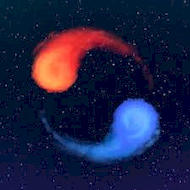
A Dance of Fire and Ice looks like a geometry game but plays like a music theory exam. Two spheres orbit each other and travel along a winding path. Your only job is to tap. The trap is believing that tapping means reacting — by the time you can see the next beat marker, it’s too late to time your input correctly. A Dance of Fire and Ice rewards players who have memorized the rhythm and are playing the song, not the screen.
Two Orbiting Bodies, One Rule
The fire sphere and the ice sphere travel together along a curved path, permanently orbiting each other at a fixed rotational speed. Every corner on the path corresponds to a beat in the song. When the spheres reach a corner, you tap — and the tap must land precisely on the beat to make the rotation. A tap too early rotates before the corner. A tap too late and the spheres spiral off the path. There is no margin system here, no “close enough” window that fills a gauge and forgives mild imprecision. A Dance of Fire and Ice operates on a single input per beat, and that input is either on time or it ends your run.
The elegance of this design is that it collapses all rhythm complexity into one action. There are no button combinations, no hold-and-release inputs, no lane switching. Every challenge the game introduces comes from making that one tap harder to time correctly — by changing the BPM mid-path, by inserting triplet rhythms against an established pulse, by overlapping two competing beat layers and asking you to follow one while the other tries to pull your attention. The simplicity of the control scheme makes the rhythm complexity land harder because there’s nowhere to hide mechanical skill behind button technique.
How the Beat Map Controls the Path
Each level in A Dance of Fire and Ice is a beat map — a visual representation of the song’s rhythm expressed as corners and curves on the spheres’ path. Straight sections between corners represent beats where no tap is required; corners are the beat moments. The shape of the path telegraphs the rhythm visually. A run of evenly spaced corners means an even pulse. Closely grouped corners mean the BPM has increased or a subdivision has been inserted. A long curved arc with no corners is a held note or rest.
This visual encoding of rhythm is what makes A Dance of Fire and Ice genuinely educational as a music game. Players who complete later worlds often describe developing an intuitive understanding of syncopation, triplet feels, and polyrhythm that they didn’t have before. The game teaches musical concepts by demanding you feel them rather than read about them — a sequence of three rapid corners followed by a longer gap is a triplet resolving into a rest, and your body learns that relationship from repetition even if your brain never consciously names it.
The implication for new players is that starting without any musical background is completely viable. The path shape communicates everything. What A Dance of Fire and Ice cannot easily communicate through visuals alone is feel — the sense of where the beat “wants” to land when the BPM shifts mid-level, which is why early playthroughs of complex worlds often feel impossible until something clicks and the rhythm suddenly sounds familiar rather than abstract.
The Worlds and What Changes Between Them
A Dance of Fire and Ice organizes its levels into worlds of increasing complexity. Each world introduces a new rhythmic concept on top of the foundations established earlier. Early worlds build comfort with consistent tempos and straightforward subdivision. Middle worlds introduce BPM changes within a single level — the path will be running at one tempo, then the corners will start arriving faster without warning. Late worlds combine multiple rhythmic ideas simultaneously: a changing tempo with triplet sections against an underlying pulse that shifts partway through.
The critical transition for most players happens around the middle worlds. Up to that point, the main challenge is consistency — not missing beats you understand but executing them cleanly across a full level without a single failed tap. Past that transition, the challenge becomes comprehension — making sense of a rhythm structure you haven’t internalized yet and finding the feel of it quickly enough to start executing cleanly.
Players frequently report that a world which felt completely impossible during one session becomes clearable a day later, without any additional practice between attempts. A Dance of Fire and Ice seems to require offline consolidation — the pattern needs to settle in the brain outside of active play before it becomes accessible. This is not a quirk; it’s a well-documented aspect of rhythm learning generally, but it’s particularly noticeable in A Dance of Fire and Ice because the gap between “this feels random” and “I can hear the pattern” is often extremely sharp.
Timing Windows and What Offset Calibration Actually Does
One of the most-asked questions from new players concerns the offset calibration setting. A Dance of Fire and Ice allows players to adjust timing offset to account for display and audio latency on their device. This is not an accessibility option — it is a technical necessity. The game is testing whether your tap aligns with the audio beat, but audio arrives at your ears slightly after the visual corner appears on screen, and different devices have different latency profiles. Without correct offset calibration, a player can be genuinely on the beat and still fail every level because the game’s internal timing doesn’t account for their setup.
Finding your correct offset requires a brief calibration process: play a simple level, count where your taps feel comfortable relative to the visual corner, and adjust the offset value until passes feel natural rather than forced. Players who skip this step and find the game feels “off” even on beats they can clearly hear are almost certainly running with incorrect offset for their device. Experienced players calibrate before starting a new device or after changing headphone or speaker setups.
The strict mode available in A Dance of Fire and Ice further tightens the input window, leaving essentially zero margin for any deviation from exact beat alignment. Strict mode is not recommended for learning levels — it exists for players who have already cleared a world and want to test whether their timing is genuinely precise or just within the standard tolerance. Some players use strict mode completions as their personal benchmark for truly owning a level, separate from a standard world clear.
Polyrhythm Sections and Why They Break Pattern Recognition
Polyrhythm sections are where A Dance of Fire and Ice stops being hard in a conventional sense and starts being hard in a specifically musical sense. A polyrhythm superimposes two different beat divisions on the same timeline — three against two, four against three, five against four. In visual path terms, this means corners arrive in patterns that don’t resolve evenly against the pulse you’ve been following. Every time you tap to what feels like a natural landing point, the corner is slightly off from where you expected.
The key insight about polyrhythm handling in A Dance of Fire and Ice is that you cannot think your way through it in real time. There is not enough cognitive bandwidth available during play to calculate where the subdivisions land against the pulse. Players who successfully navigate polyrhythm sections describe either locking onto one of the two rhythms and following it mechanically, or reaching a state where the combined rhythm becomes its own pattern distinct from either component. The second approach is faster to execute but requires more repeated exposure to the specific section before it clicks.
A common beginner error in polyrhythm sections is trying to compensate mid-fail by half-adjusting timing. This produces cascading errors because the sections are designed around either/or commitment — you’re in one rhythm or the other. Attempting to split the difference produces taps that fit neither, which fail more consistently than committing fully to the wrong rhythm and at least generating a recognizable failure pattern to learn from.
Practice Mode and Its Specific Limitations
A Dance of Fire and Ice includes a practice mode that lets players start from the beginning of a level and repeat it without needing to complete the full world. This is how most players approach difficult sections — run the level in practice mode until the problematic corner sequence becomes instinctive, then attempt the full run. Practice mode is effective for internalizing rhythms but has a specific limitation worth knowing.
The mental state during a practice run is different from the mental state during a serious attempt. In practice mode, there’s no consequence for failure beyond losing a few seconds of replay time. Serious attempts carry the weight of all the effort invested in reaching that point and the knowledge that a single missed tap ends the run. Players who can execute a section flawlessly in practice mode sometimes find it falls apart on serious attempts because the cognitive load of consequence-awareness slightly disrupts the automatic processing that clean execution requires. This is the same “choking” phenomenon that affects long runs in any reflexive game, but A Dance of Fire and Ice’s zero-tolerance input system makes it particularly visible.
The recommended approach is to practice a difficult section until you can fail it deliberately — until you understand not just what the correct timing feels like but exactly what wrong timing produces. Players who can fail on demand have fully internalized the correct timing as a reference point, which is more resilient under pressure than players who can pass on demand but can’t articulate why.
Why Listening Matters More Than Watching
The most significant improvement in A Dance of Fire and Ice performance comes when players stop watching the path and start listening to the song. The visual path is a map; the audio is the actual territory. On levels where BPM changes without warning, players who rely on visual corner detection will always respond too late because visual processing trails audio processing at the rhythm speeds the game operates at. Players who are tracking the song’s feel — its phrasing, its energy changes, the way it breathes before a difficult section — anticipate BPM shifts before the corners reflect them visually.
This is a counterintuitive instruction for a game that looks like a visual puzzle. A Dance of Fire and Ice looks like it rewards visual precision, but its difficulty ceiling is ultimately determined by how well a player has learned the specific song a level is built on. Repeated exposure to the audio changes the game’s character completely. A level that felt like a visual obstacle course on the first ten attempts often starts to feel like playing a song by the thirtieth — a thing with shape and momentum and predictable peaks, not an unpredictable stream of corners.
Players who dislike A Dance of Fire and Ice typically dislike it because they find the repetition of failed attempts tedious rather than informative. This is a genuine and fair criticism — the game’s learning curve requires tolerating a lot of near-identical failures before improvement appears. For players who can reframe repeated failure as rhythm practice rather than game failure, A Dance of Fire and Ice becomes one of the most satisfying rhythm experiences available, specifically because the satisfaction of a clean level clear is attached to actually having learned a piece of music rather than just a pattern of button presses.
A Dance of Fire and Ice earns its reputation for difficulty by refusing to separate musical understanding from gameplay success. The fire sphere and the ice sphere don’t care about your reaction time — they care about whether you’ve listened to this section enough times that the rhythm lives in your hands rather than your mind. The strict mode completion of a late world, where the input window has essentially no tolerance, feels like a different kind of achievement from a video game clear precisely because it required learning something real. That combination of genuine musical demand and pure single-button control is what keeps players returning to earlier worlds with newly calibrated ears, finding rhythms they missed the first time and wondering how they ever found them confusing.