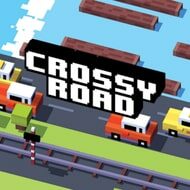
You hop the Chicken across the first road, then the second, then a river on logs — and then you stop to look at a lily pad one second too long and the eagle swoops. That eagle is Crossy Road’s most honest design decision: the game doesn’t just punish collisions, it punishes hesitation. Standing still isn’t safe; it’s a countdown. Crossy Road wants you to keep moving, and the eagle is what happens when you forget that.
| Genre |
Casual / Arcade Hopper |
| Platforms |
iOS, Android, Browser |
| Release Year |
2014 |
| Characters Available |
150+ unlockable characters |
| Objective |
Hop as far as possible without getting hit or hesitating |
The Three Terrain Types and Their Rules
Crossy Road generates its world from three repeating terrain types, each with its own movement logic:
- Roads — cars, trucks, and buses travel in horizontal lanes at varying speeds. The character must time hops across each lane to avoid vehicle collisions. Vehicles travel in alternating directions per lane. At high distances, vehicle speeds increase and lane counts grow. The key skill on roads is reading vehicle speed and gap frequency before committing to a crossing, not reacting to vehicles after entering a lane.
- Rivers — water that cannot be crossed directly. Logs and lily pads float across the river surface and must be used as stepping stones. The character hops onto a moving log and travels with it while planning the next hop. Getting carried too far to the edge of the screen on a log, or hopping to a lily pad that submerges, ends the run. River speed increases over the course of a run, compressing the window available to hop between logs and pads.
- Train tracks — trains arrive from the side at high speed with little warning. The whistle sound is the primary warning signal; experienced players listen for the whistle before hopping onto tracks rather than relying on visual detection. Trains move fast enough that visual detection on entry is often too late.
Grass sections between terrain types function as safe resting zones. No vehicles, no water, no trains. The eagle timer continues during grass sections, which means that prolonged pauses on grass are just as deadly as prolonged pauses anywhere else. This prevents grass from functioning as a genuine recovery zone; it’s a transition space, not a rest.
The Eagle Timer and Why It Defines Crossy Road
The eagle is Crossy Road’s second death condition. It circles above and dives after approximately five to seven seconds of the character standing still. The eagle targets the character’s current position, giving a brief warning animation before the strike. Moving forward (in any direction other than backward) resets the eagle timer. Moving backward does not reset it — moving backward moves the camera and can pull the eagle’s focus, but the underlying timer behavior encourages continuous forward progress.
The eagle is what makes Crossy Road a game about consistent progress rather than positional safety. In most obstacle games, stopping and waiting for a safe window is the correct strategy. In Crossy Road, waiting is only valid for the duration of the eagle timer. A player who identifies a safe gap on the next road but waits for a wider one must execute the crossing before the eagle arrives, regardless of whether a wider gap has appeared. The eagle forces acceptance of “good enough” windows rather than perfect ones, which is a specific kind of decision-making skill that translates poorly from safer obstacle games.
Experienced Crossy Road players describe a mental model they call “forward debt” — the awareness that every second spent waiting for a safe crossing is a second closer to the eagle. Managing forward debt means always executing a crossing before the eagle timer peaks, which means accepting worse crossing windows than would feel comfortable without the eagle pressure. Players who have internalized this model consistently outperform players who approach Crossy Road with a pure-safety mindset.
Character Unlocks and the Gift System
Crossy Road’s 150+ characters are unlocked primarily through the prize machine — an in-game slot that produces random character unlocks for coins collected during runs. Coins appear on terrain sections and are collected by hopping through them. The coin prize machine has a specific probability distribution that the community has analyzed extensively: common characters appear more frequently than rare and premium characters. Some characters are only available through direct purchase and cannot be obtained through the prize machine at any frequency.
Several characters modify the game environment when selected. The Android character replaces the visual theme with a futuristic version of the terrain. The Forget Me Not character replaces the terrain with a night-bloom floral setting. The Piggy Bank character fills a meter that, when full, produces a coin bonus at the end of a run — incentivizing longer runs rather than simply accepting death. These environmental and mechanical character modifications give the character system a depth beyond cosmetics that most unlock systems in similar games don’t offer.
The rarest characters in Crossy Road are specific reskins tied to event periods or premium unlocks. The community tracks which characters have the highest unlock rates through the prize machine and which require direct purchase. One consistent point of community friction is the premium character pricing — some highly sought characters (particularly those with meaningful gameplay modifications) are priced outside the free coin prize machine, which creates a tension between the game’s accessible character-hunting loop and the monetization of the most interesting mechanical variations.
Log Drift and River Mechanics at High Distance
The river sections become the primary high-distance difficulty driver in Crossy Road. As distance increases, log and lily pad movement speed increases while the available hopping window between moving platforms compresses. Players at low distances can comfortably board a log, travel several squares with it, and select the next platform at a comfortable pace. Players at high distances board a fast-moving log that carries them to the screen edge within two seconds and must identify and execute the next hop within that window or be lost to the edge scroll.
A specific river technique that separates high-distance players from average ones is counter-hopping — hopping against the direction of the current log’s movement to slow lateral drift while waiting for a forward-moving platform to align. Counter-hopping is counterintuitive because it feels like backward movement, but in Crossy Road’s hop system, a lateral hop against the log’s movement direction uses the log’s travel to keep the character roughly stationary on the screen while the next platform approaches. This is only reliably executable with logs moving at moderate speed; fast logs at high distance allow insufficient time for counter-hopping maneuvers.
High Score Strategies
High scores in Crossy Road come from two sources: total distance hopped and coins collected per run. Both can be optimized independently, but the strategies partially conflict. Maximum distance requires conservative crossing decisions and consistent eagle-timer management. Maximum coins requires sometimes routing through coin-heavy terrain even when a safer adjacent crossing would avoid coin zones entirely.
Players with very high Crossy Road scores typically use a hybrid approach: prioritize forward progress (and thus eagle-timer management) while collecting coins opportunistically when coin hopping doesn’t meaningfully increase risk. The specific ratio of distance to coin value depends on the character being run — some characters increase coin values, which shifts the optimal balance toward more coin-focused routing at the cost of some safety margin.
The community distinguishes between “lucky high scores” — runs where the terrain generation produced an unusual number of wide vehicle gaps and slow rivers — and “skill high scores” — runs where the terrain was average but eagle-timer management and log-drift control were executed at a high level. The procedural terrain generation means luck always plays some role in peak scores, but the community consensus is that the skill component dominates over long-session averages, and that consistent average scores across many runs are a better measure of actual skill than any single peak performance.
Common Questions About Crossy Road
Does the terrain in Crossy Road have an end?
Crossy Road’s terrain is procedurally generated and has no defined endpoint. The world generates infinitely forward as the character progresses, with terrain type, vehicle speed, river speed, and environmental complexity all scaling upward as distance increases. There is no victory condition other than achieving a personal best distance. In practice, the speed scaling eventually produces vehicle and river configurations where the eagle timer and obstacle speed combine to make indefinite survival theoretically impossible — but the distance at which this practical ceiling is reached is far beyond what most players experience in typical sessions.
What’s the fastest way to unlock characters in Crossy Road?
Collecting coins efficiently during runs and using them on the prize machine is the fastest path to unlocking common characters. Players who route through coin-heavy terrain sections without significantly sacrificing distance accumulate coins faster than players who ignore coins entirely. The Piggy Bank character (if already unlocked) generates additional coin bonuses from long runs, creating a compounding efficiency for players who use it to farm coins for prize machine pulls. Attempting runs specifically for coin accumulation — accepting early death after collecting dense coin sections rather than attempting maximum distance — is a legitimate strategy for players who are trying to unlock specific characters through the prize machine.
Why do some Crossy Road characters feel harder to play than others?
Characters with modified environmental settings — particularly those that change the terrain visual theme — occasionally have the unintended effect of making vehicle speed or timing slightly harder to read against the new visual background. The Android character’s metallic terrain, for example, can create slight visual ambiguity between static terrain and moving vehicles that doesn’t exist in the standard green and yellow environment. Most players adapt to these visual variations within a few runs, but the first few sessions with a new environmental character almost always produce lower scores than equivalent runs with the standard environment, regardless of the player’s base skill level with the game.
Crossy Road’s longevity comes from the combination of its eagle mechanic and its character system — two design decisions that seem separate but reinforce each other. The eagle teaches constant forward momentum. The character system gives players a reason to generate that momentum across hundreds of runs over long periods. The Chicken that started everything is still available on screen after 150 unlocks later, hopping across the same procedurally generated roads and rivers that have produced millions of eagle-dive failures. Every hop forward is still a decision about gap timing, log drift, and forward debt that no amount of character unlocks reduces to autopilot.