What actually happens the moment you slam a magazine into a pistol backwards, hear the slide jam, and realize the fix will take longer than just hurling the gun at the guy in front of you? In BONELAB that split-second decision is normal, not a glitch, and it is the clearest sign you are playing a physics sandbox rather than a scripted VR shooter. The game hands you a body, a belt, and a room full of interactive objects that do not care whether you understand them yet.
| Genre |
Physics-based VR action sandbox |
| Platform |
Meta Quest headsets and PC VR via SteamVR |
| Release Year |
2022 |
The Marrow Engine and Physical Combat in BONELAB
Everything that makes BONELAB feel different from a normal VR shooter traces back to the 1Marrow Interaction Engine running underneath it. Marrow drives a seven-point IK skeleton paired with a much denser physics body covering the torso and head, so your arms, hands, and even a gun’s slide are simulated objects with mass and momentum rather than animated props. That is why a pistol can genuinely jam if you seat the magazine wrong, why a punch that connects with a doorframe hurts your own hand as much as an enemy’s face, and why grabbing a ledge with two hands actually holds your weight instead of triggering a canned climb animation.
Players coming straight from flatscreen shooters tend to fight this system for the first hour, yanking weapons like they would tap a reload button and getting stuck fumbling with a mag that will not seat. The ones who stick with it stop treating the gun as an icon and start treating it as an object: check the chamber, seat the mag, rack the slide, in that physical order. Community shorthand for when the simulation does something unexpected but hilarious is calling it jank, and BONELAB players use the word with real affection.
The belt-based inventory carries the game’s physical logic even further: shoulders, hips, and chest slots where you holster weapons and gear by hand rather than pulling them from a menu. Melee weapons follow the same rules as everything else, so a crowbar swing that clips a wall deflects unpredictably, and a two-handed grip on a heavy prop genuinely changes how much force lands behind a swing.
Swapping Avatars in the BONELAB Bodymall
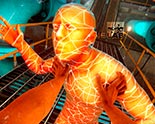
The Bodymall inside the hub is where BONELAB’s identity really separates itself. Every avatar you unlock carries its own stats calculated from the model’s proportions, and Marrow tracks eight of them per body.
- Height and Mass shape how hard your melee hits land and how easily you get shoved around in return
- Agility and Speed control how fast you can juke an incoming swing or sprint between cover
- Strength Upper and Strength Lower affect grip force, climbing, and how far you can throw an object
- Vitality and Intelligence round out how much punishment a body can take and how it responds under pressure
Swap into a taller, heavier body and your punches land harder but your dodges get sluggish; drop into something small and light and you move fast but get knocked around like a ragdoll yourself, because you basically are one. This is not a cosmetic wardrobe — combat trials and boss encounters play out differently depending on which avatar you are wearing, and that single design choice is what keeps veteran players cycling through the Bodymall instead of settling on one favorite body forever.
Some early avatars feel noticeably underpowered next to unlocked ones, and that gap is one of the more common complaints on BONELAB forums — a few stat combinations make certain arenas frustrating until you find a body that actually suits your playstyle.
The Hub, MythOS, and Modding Through mod.io
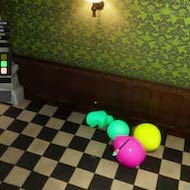
The story opening drops you into an underground lab beneath MythOS city, and from there the Special Projects Area, usually just called the Hub, becomes home base for the rest of the run. Six modules branch off from it, gating story sequences, combat arenas, obstacle-course challenges, tactical trials, open sandboxes, and experimental modes that exist mostly to let you break the physics on purpose.
Early on you are mostly following objective markers and learning the belt system. By the time you have cleared a couple of the combat-focused modules, the game stops holding your hand and starts expecting improvisation: throwing an empty gun as a blunt weapon, using a fire extinguisher as an impromptu battering ram, dragging a downed enemy’s body to block a doorway. Completionists gravitate toward the arcade cabinets scattered through the Hub, since clearing their minigames is tied to unlocking additional avatars and cosmetic rewards.
A huge share of the long-term audience plays almost entirely through mod.io, downloading community avatars, weapons, and full levels built with the Marrow SDK. Speedrunners tend to stick to vanilla content since mods can break routing and timing, while sandbox-focused players treat mod.io as the actual endgame. Performance is the other side of that conversation: the standalone Quest version scales back geometry and effects compared to the PC VR release, and players who expected identical fidelity on a headset alone are usually the ones posting about the visual downgrade.
Is BONELAB worth playing if you already finished Boneworks?
Yes, mainly because of the avatar system — the earlier game locked you into one body for the whole campaign, while BONELAB turns swapping bodies into a core mechanic that changes how every fight and every climb feels. The Hub and its six modules also give you a reason to keep coming back after the story wraps, which the original never really offered.
How long does it take to see everything in the BONELAB Hub?
The main story sequences can be finished in a handful of sessions, but clearing every arcade cabinet, unlocking every stock avatar, and running the combat and tactical trial modules takes considerably longer, and most players never touch every experimental mode without pulling in mod.io content.
Does BONELAB run well on a standalone Quest headset?
It runs, but with visibly reduced texture and lighting fidelity compared to the PC VR version through SteamVR, and busy physics-heavy scenes can dip in framerate on Quest hardware — a tradeoff most standalone players accept in exchange for not needing a gaming PC at all.
BONELAB earns its reputation the hard way, by making you learn its physics instead of memorizing a moveset, and the Marrow engine underneath it still makes a jammed magazine feel like a genuine emergency instead of an animation. Once you have swapped through a few avatars in the Bodymall and felt how differently a heavy body punches compared to a light one, going back to a scripted VR shooter feels flat by comparison.