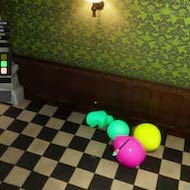
You toss your first dart at the board in Fortune Mill and watch a single dollar blink onto the counter. One million feels impossible from here, and that gap between where you start and where the exit sits is the whole point of this game. It closes faster than the opening minutes suggest, especially once you stop treating every room like a manual chore.
| Genre |
Incremental / Idle |
| Setting |
A locked facility made of four connected rooms |
| Objective |
Reach $1,000,000 in each room to earn your way out |
| Core Loop |
Earn, upgrade, automate, then reinvest across rooms |
Room Progression and the Escape Goal in Fortune Mill
The first room hands you a wall and a handful of darts, and that’s genuinely it at the start — throw, collect a dollar or two, throw again. What changes the equation is the shop sitting right next to the board, where early upgrades boost payout per throw, widen the bullseye, and eventually let you throw more than one dart per go. Room 2 swaps darts for scratch-off tickets, and the first ticket you flip pays out around six dollars, which feels laughable next to the seven-figure target attached to it.
Room 3 introduces dice, and this is where players who’ve been coasting on room 1 habits usually stall, because dice rewards scale off multipliers rather than raw upgrades. Room 4 is the one people mention most in conversation, since it swaps gambling mechanics for a small cooking loop where you’re assembling sushi for payouts instead of pulling a lever.
None of the four rooms function in isolation. Upgrades bought in one room quietly raise ceilings in the others, which is the synergy the whole structure is built around, and it’s also why jumping between rooms early tends to outperform grinding one room to completion before touching the next.
Automating the Rattling Gunner and Early Bottlenecks
The Rattling Gunner is the automation unit for room 1, and getting it unlocked is the first real turning point in a run. Before it exists, every dollar comes from a manual click; after it exists, darts fly on their own while you’re free to manage room 2’s ticket queue or room 3’s dice. Newer players consistently under-invest here, spending too long manually clicking room 1 instead of pushing toward automation the moment it’s affordable.
A tax-cheating accountant figure works the scratch-ticket counter in room 2, and hiring that role early does more for long-term income than most single upgrades in the game, since it removes the need to babysit ticket purchases by hand.
Casual players tend to treat each room as a separate mini-game to be “finished,” while optimizer-minded players chase full automation across all four before touching Lethal Mode. Both approaches work, but the pacing feels very different depending on which one you pick.
Jackpots, Dice Multipliers, and the Sushi Loop
Room 2 jackpots are the detail beginners overlook most. Hitting one doesn’t just pay out gold once — it applies a permanent bonus that stacks across every other room, which makes room 2 worth prioritizing even for players who find scratch tickets the least exciting of the four loops.
Room 3’s dice rolls apply multipliers to earnings everywhere else, so a lucky sequence here can make room 1’s darts or room 4’s sushi suddenly worth several times more than they were an hour earlier.
- Room 1 — direct payout upgrades and automation via the Rattling Gunner
- Room 2 — scratch tickets, hired help, and permanent jackpot bonuses
- Room 3 — dice rolls that multiply income across all rooms
- Room 4 — sushi cooking with unique game-altering effects
Fifteen different creatures can be befriended or bribed as you progress, including a seal and a frog who show up in almost every screenshot players share when comparing collections.
Lethal Mode and New Game+ in Fortune Mill
Lethal Mode unlocks after your first full escape and adds strict timers to each room, turning what was a relaxed idle loop into something closer to a speedrun. Community discussion around Lethal Mode timing is dense, since certain rooms — the gold room in particular — need runs completed inside a specific window rather than just eventually.
New Game+ is the reward structure tied to a completed escape, unlocking cosmetic hats tied to Box #724, the container you were originally meant to be shipped inside. Whether later New Game+ cycles add anything beyond scaled difficulty is a genuinely open question among players still working through repeat runs.
How do you unlock automation in Fortune Mill?
Automation for each room is purchased through that room’s own upgrade shop once you’ve accumulated enough gold from manual play, starting with the Rattling Gunner in room 1, which is generally the first automation worth prioritizing.
Does New Game+ actually reward you with anything new?
New Game+ grants cosmetic hats and a fresh scaling curve, though players comparing NG+2 and NG+3 runs still debate whether later cycles add meaningful new incentives beyond raw difficulty.
What’s the trick to beating Lethal Mode?
Lethal Mode hinges on hitting per-room timers rather than just reaching the dollar goal, so runs need automation and synergy upgrades from a normal playthrough already in place before the timer pressure becomes manageable.
Fortune Mill turns a simple premise — throw darts until you’re rich enough to leave — into a surprisingly deep web of overlapping upgrade paths, and watching the Rattling Gunner take over room 1 while you’re still deciding what to do with room 3’s dice is the moment the whole design clicks into place.