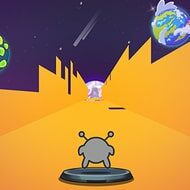
The wave form in Geometry Dash does not forgive the micro-timing adjustments that made the cube feel manageable. The cube lands on platforms, giving players a clear binary — jump or don’t jump. The wave flies through narrow corridors where holding the button moves it up and releasing moves it down, and the required correction is continuous rather than discrete. Players who carry cube-form instincts into a wave section will overcorrect every time and clip walls they had enough room to pass through cleanly.
| Genre |
Rhythm Platformer |
| Platforms |
Mobile, PC, Browser |
| Release Year |
2013 |
| Official Levels |
21 (base game + updates) |
| Difficulty Tiers |
Easy through Extreme Demon |
The Cube and Its Other Forms
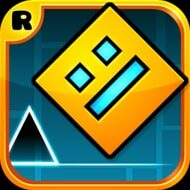
Geometry Dash begins every official level with the cube — a square icon that jumps when tapped. This is the most forgiving of the game’s forms. The cube lands on platforms, its jumps have a consistent arc, and timing errors are usually legible in the sense that you can see which spike or platform edge caught you. The cube teaches the core skill of Geometry Dash: matching your taps to the song’s beat so that jumps align with obstacles by rhythm rather than visual reaction.
The other forms remove that rhythm-jump alignment in different ways. The ship flies up when held and descends when released, demanding constant micro-adjustment rather than discrete taps. The ball rolls along surfaces and gravity-flips when tapped, which inverts the expected relationship between tapping and upward movement. The UFO generates short bursts of lift on each tap, requiring staccato input rather than the sustained or absent input that the ship uses. The wave, mentioned above, is a continuous angled beam where held equals diagonal-up and released equals diagonal-down — and because the angle is steeper than players expect, every corridor feels narrower than it looks on first approach.
The robot and spider forms appear in later levels and introduce timing-dependent jump heights: the robot’s jump height is determined by how long the button is held, and the spider teleports between floor and ceiling based on tap timing within a rhythm grid. Understanding when each form appears and what cognitive adjustment it requires is one of the core skills of Geometry Dash. Transitions between forms within a single level are where most deaths occur, because the input model changes mid-run and players sometimes carry the previous form’s rhythm forward by reflex.
Official Levels and What They Actually Test
Geometry Dash’s official levels are designed around a specific philosophy: each one introduces or emphasizes one form or mechanic while building on what came before. Stereo Madness, the first level, is primarily cube with one brief ship section that introduces gravity inversion at the lowest possible speed. Polargeist is the first level where the ball form appears, and it deliberately gives players long, uncrowded sections to feel how the gravity flip works before adding real obstacles. By the time players reach Clubstep, the ninth official level and the first rated Demon, every form has appeared and the challenge becomes executing all of them at speed with obstacles tight enough that a single misread ends the run.
The official levels also communicate difficulty through color and visual density. Early levels have simple backgrounds with sparse obstacles and clear visual contrast between safe ground and instant-death spikes. Later levels like Theory of Everything 2 and Deadlocked add moving parts, overlapping visual elements, and effects that make the death objects harder to read at first glance. This visual complexity is intentional — it is part of the difficulty, not a separate decoration layer. Players who struggle with later levels often find that slowing down their visual processing — ignoring the background effects and focusing on the immediate obstacle zone — reduces difficulty significantly on first attempts.
How Demon Difficulty Actually Works
The Demon difficulty tier in Geometry Dash is subdivided into five levels: Easy Demon, Medium Demon, Hard Demon, Insane Demon, and Extreme Demon. This subdivision exists in the community rating system for user-created levels and is retroactively applied to official Demon levels. Clubstep is generally rated Easy Demon. Theory of Everything 2 is Hard to Insane Demon depending on the player’s background with the ship form. Deadlocked is considered Medium to Hard Demon by most of the community.
Extreme Demon is the community’s label for levels that represent the absolute ceiling of current human execution — levels that require months of daily practice for most players to complete. The most notorious Extreme Demons are user-created rather than official; the game’s level editor has produced obstacles with tolerances so tight that completing them is considered a significant achievement within the community regardless of the player’s overall skill level. The distinction between Insane and Extreme Demon matters because it frames the time investment honestly: an Insane Demon at high skill takes days to weeks, an Extreme Demon at high skill takes months.
Practice Mode, Checkpoints, and Their Limitations
Practice mode allows players to run through a level with auto-placed or manually placed checkpoints — green rings that save position and restart from that point on death rather than from the level beginning. This is the primary learning tool for Geometry Dash and how most players approach levels above their current consistent execution level.
The limitation of practice mode is what the community sometimes calls “practice mode syndrome” — the state where a player can pass a section repeatedly in practice but fails it consistently in a normal run. Practice mode creates different psychological conditions than a real run. In practice, death at a checkpoint costs three seconds. In a normal run, death at the same point costs everything invested in reaching it. The cognitive load of that difference slightly disrupts the automatic execution that clean runs require. Players who develop strong practice mode performance sometimes find they need a separate conditioning phase of simply attempting normal runs, accepting early failures, and building tolerance for the pressure of a real attempt before the practice-mode skills transfer cleanly.
The Level Editor and User-Created Content
Geometry Dash’s level editor is the source of most of its longevity and community activity. Players create and share levels through the in-game level database, which contains millions of user-created levels across all difficulty tiers. The editor supports nearly every element that appears in official levels, plus additional visual and mechanical options that the official levels don’t fully use. This has produced user-created levels that are visually and mechanically more elaborate than the official content in many cases.
The most celebrated user-created levels carry reputations within the community that rival or exceed the official levels. Bloodbath, Sonic Wave, and Tartarus are known as benchmarks for extreme difficulty. Completing any of these is considered a statement about a player’s overall ability level. The community maintains lists of the current hardest levels, and these lists update as new levels are created and verified.
A meaningful criticism of user-created content is accessibility for less experienced players. The level database contains an enormous amount of content, but finding levels at an appropriate difficulty for intermediate players is not straightforward. The search and filter tools exist but are not intuitive, and the community rating system — which determines difficulty labels — is applied by votes and can be inconsistent for newer or less popular levels. Players in the three-to-six-month skill range often describe a gap in the level difficulty distribution where official levels feel too easy but most community-highlighted levels feel inaccessible.
Orbs, Stars, and What They Actually Unlock
Geometry Dash’s progression currency comes in three forms. Stars are awarded for completing levels — two stars for a normal completion, three for collecting all user coins within the level as well. Stars accumulate across all completed levels and serve as the primary gating mechanism for unlocking certain features and icons. Orbs are earned from practice mode completions and some in-game rewards and are spent in the shop to purchase icon cosmetics — different cube skins, ship forms, color trails, and death explosions. User coins, the third currency, are hidden within levels and collected during a run; some official levels award special icons for collecting all user coins in addition to the star bonus.
None of these currencies affect gameplay ability. Geometry Dash’s progression is entirely cosmetic, which is both a design strength and a source of occasional community debate. Players who want a sense of mechanical progression tied to their improving skill sometimes feel the star system doesn’t adequately represent the gap between completing Stereo Madness and completing Deadlocked. The community has developed its own informal progression markers — demon completions, percentage reached on a currently-impossible level, verified completions of self-created levels — that function as the actual skill progression indicators outside of the official currency system.
Common Questions About Geometry Dash
Why does Geometry Dash feel harder on some devices than others?
Geometry Dash’s physics are tied to the frame rate of the device running it. At lower frame rates, the game’s physics behave differently than at higher frame rates, which can make certain timing windows feel wider or narrower. The game is designed around a 60 frames-per-second baseline. Devices running below that — particularly older phones or low-power browsers — produce a slightly different physical experience that makes some sections harder or easier in ways that don’t transfer to other players’ setups. This is a longstanding technical issue the community is aware of.
Is there a way to make user coins show up in practice mode?
User coins are not collected in practice mode. They only register during a normal run of a level where no checkpoints have been used. This means collecting user coins requires first learning the level well enough to run it cleanly without practice mode assistance, then specifically routing through the coin locations on a clean attempt. For levels with particularly difficult coin placements, this significantly extends the time investment compared to a basic level completion.
What is the actual fastest way to get better at Geometry Dash as a beginner?
Complete the official levels in order without skipping. Each level’s design introduces a concept that appears in the next, and skipping levels leaves gaps in form familiarity and timing calibration. Practice mode is appropriate for levels where normal attempts produce failures within the first few seconds of the level. For levels where failures happen past the halfway point, normal attempts produce better results than practice mode because they build the execution stamina needed for long clean runs.
Geometry Dash is a game about a cube that jumps — and also about a ship that inverts, a ball that flips gravity, a wave that threads corridors, and a robot whose jump height depends on input duration. Each of those forms answers the same underlying question differently: how precisely can you match your inputs to a rhythm while the visual environment escalates in complexity? The answer improves over hundreds of attempts, death by death, until the spike that ended run eighty-seven is just a memory and the level that once felt impossible plays from memory like a piece of music you’ve practiced so many times that your hands know where to go before the notes arrive.